
All explainers · Agent-based simulation, explained
Charypar–Nagel: how an agent values time at an activity
Animation paused (reduced motion). Press play to watch.
In one sentence
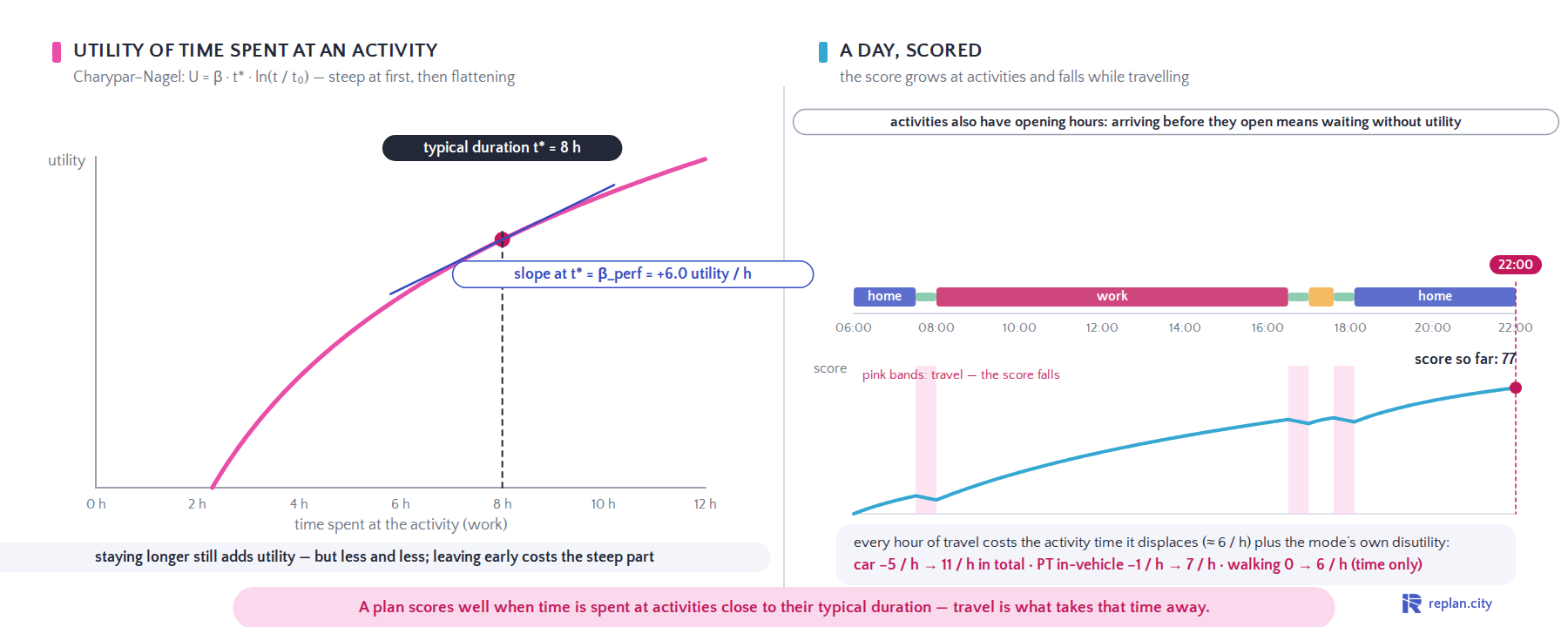
A plan scores well when time is spent at activities close to their typical duration — travel is what takes that time away.
Why it matters
Utility grows with the logarithm of the time spent at an activity: steep at first, flattening around the typical duration, where the slope equals the performing rate (+6 utility per hour in this model). A day is scored as it happens — up during activities, down while travelling — so an hour on the road costs the activity time it displaces plus the mode’s own disutility.
Agent-based simulation is usually explained with equations or with a screenshot of a running model. Neither shows why a planner should care. These explainers show the mechanism itself — one person, one day, one score — so that the results on a dashboard stop being a black box.
Sources
- Charypar, D. & Nagel, K. (2005): Generating complete all-day activity plans with genetic algorithms. Transportation 32(4)
- Scoring parameters are typical MATSim values (illustrative); see Horni, Nagel & Axhausen (2016), ch. 3
What you see
- 00.0Utility curve of an activity
- 04.0Marginal utility after 7.8 h
- 07.0Typical duration t* = 8 h
- 09.0A day, scored
- 14.0Travel costs activity time
- 17.0Takeaway
Use this explainer
MP4 (1800×720) · GIF (1200 px) · Poster (PNG)

Embed: <iframe src="https://www.replan.city/explains/embed/charypar-nagel?lang=en" width="900" height="360" style="border:0;max-width:100%;aspect-ratio:5/2" loading="lazy" title="Charypar–Nagel: how an agent values time at an activity"></iframe>
Paste into any page; the explainer plays as live SVG (no video file).
Licence: CC BY 4.0 — reuse freely with the line “Replan GmbH · replan.city/explains”. The Replan mark in the corner stays.
More: Comparison with Replan
See it on your own network
Book a demoRelated explainers
The same person’s day, played out
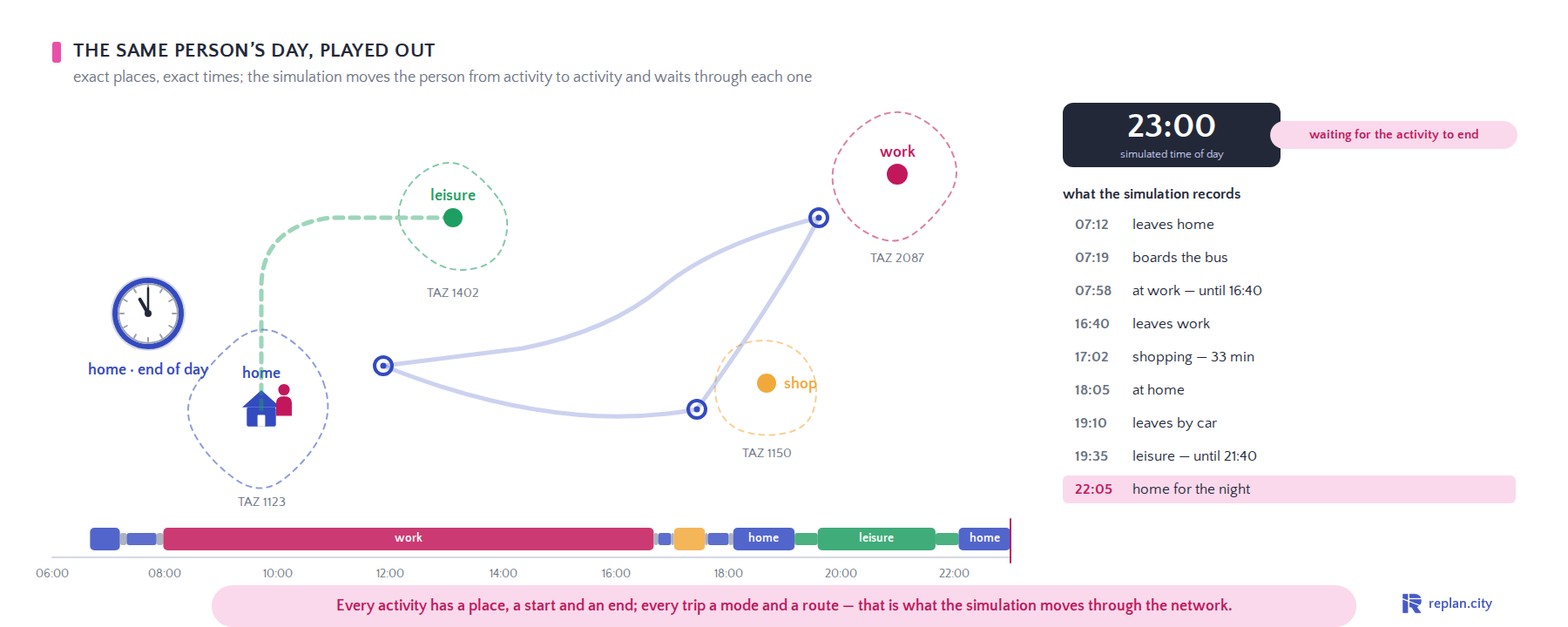
Every activity has a place, a start and an end; every trip a mode and a route — that is what the simulation moves through the network.
The scoring function at work
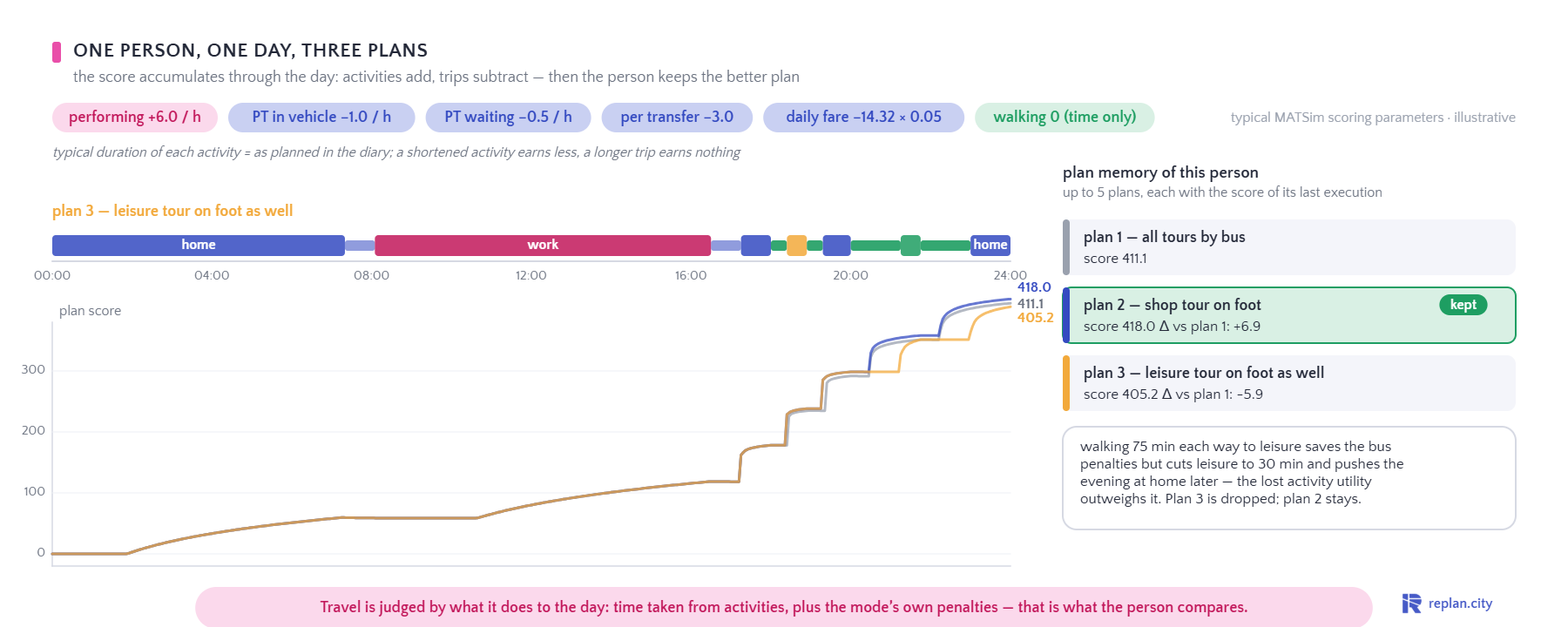
Travel is judged by what it does to the day — that is what the person compares.
The MATSim loop
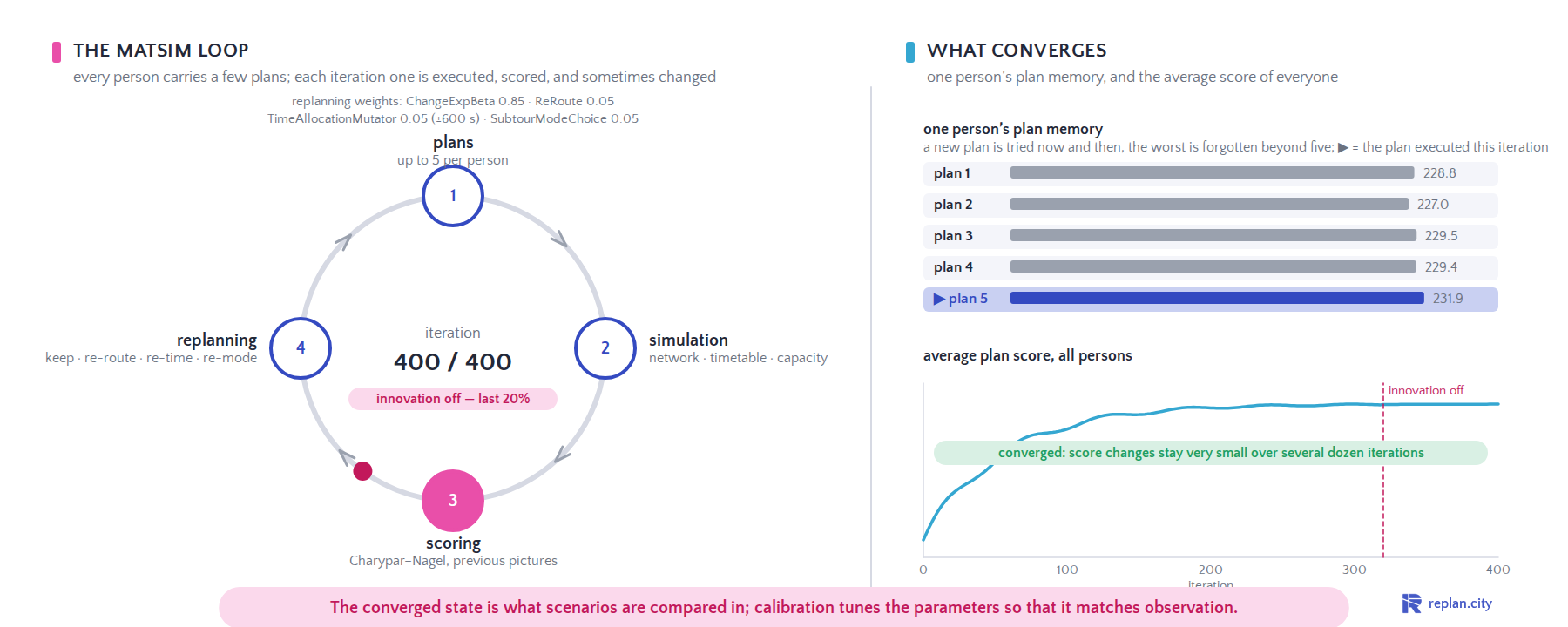
The converged state is what scenarios are compared in; calibration tunes the parameters so that it matches observation.