
All explainers · Agent-based simulation, explained
The MATSim loop
Animation paused (reduced motion). Press play to watch.
In one sentence
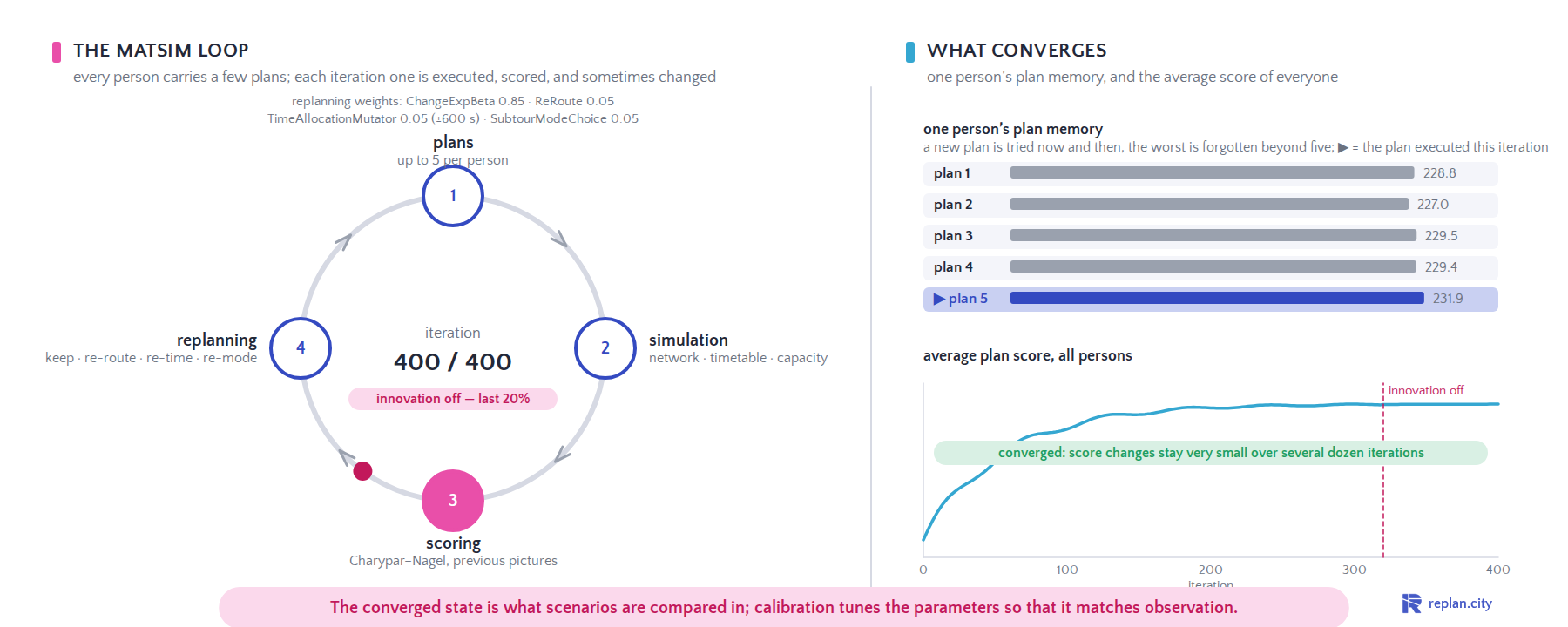
The converged state is what scenarios are compared in; calibration tunes the parameters so that it matches observation.
Why it matters
Every person keeps up to five plans. Each iteration one plan is executed on the network and timetable, scored, and in replanning either kept (85 %) or changed — a new route, shifted times, another mode for a subtour (5 % each). Over 400 iterations the plan memory fills, the worst plan is forgotten, and the average score flattens; for the last 20 % innovation is switched off.
Agent-based simulation is usually explained with equations or with a screenshot of a running model. Neither shows why a planner should care. These explainers show the mechanism itself — one person, one day, one score — so that the results on a dashboard stop being a black box.
Sources
- Scoring parameters are typical MATSim values (illustrative); see Horni, Nagel & Axhausen (2016), ch. 3
- Horni, A., Nagel, K. & Axhausen, K. W. (eds.) (2016): The Multi-Agent Transport Simulation MATSim. Ubiquity Press
What you see
- 00.0Plans → simulation → scoring → replanning
- 02.0Plan memory fills
- 06.0Average score rises
- 14.0Innovation off, last 20 %
- 17.0Converged
Use this explainer
MP4 (1800×720) · GIF (1200 px) · Poster (PNG)

Embed: <iframe src="https://www.replan.city/explains/embed/matsim-loop?lang=en" width="900" height="360" style="border:0;max-width:100%;aspect-ratio:5/2" loading="lazy" title="The MATSim loop"></iframe>
Paste into any page; the explainer plays as live SVG (no video file).
Licence: CC BY 4.0 — reuse freely with the line “Replan GmbH · replan.city/explains”. The Replan mark in the corner stays.
More: Comparison with Replan
See it on your own network
Book a demoRelated explainers
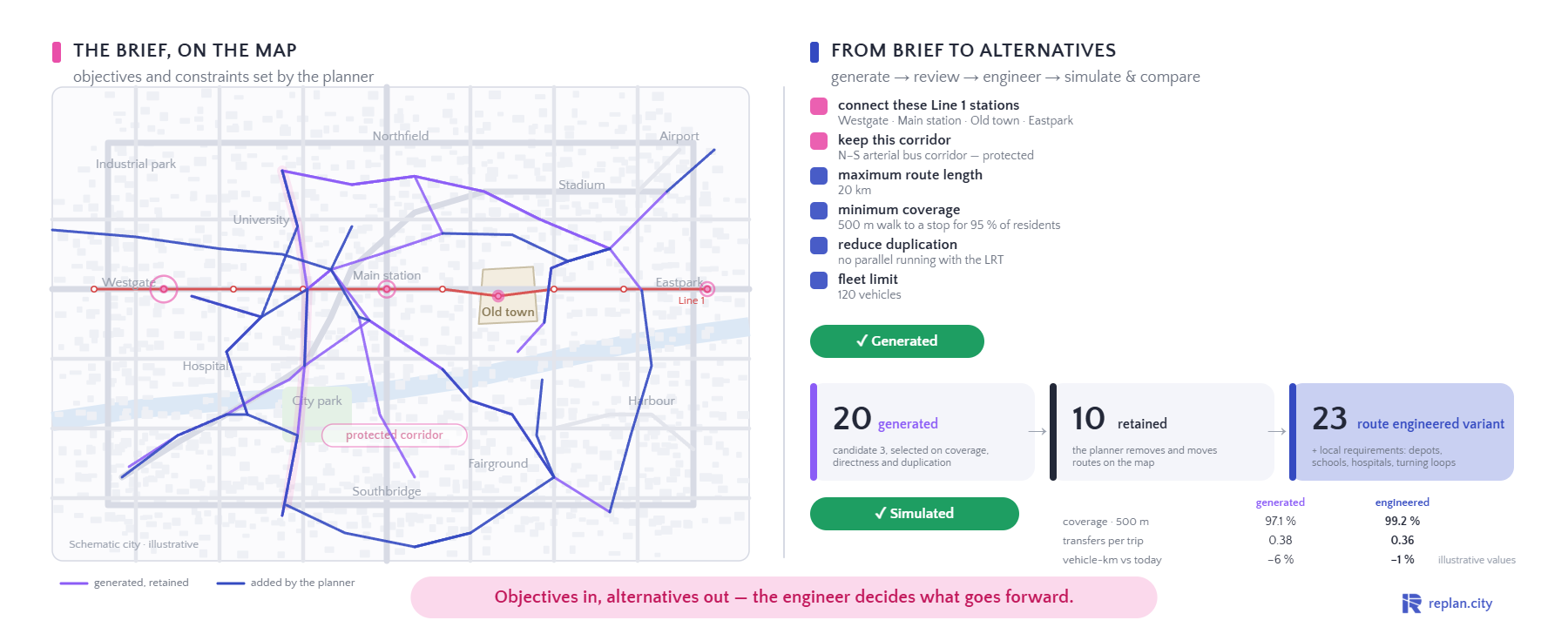
From planning objectives to network alternatives
Objectives in, alternatives out — the engineer decides what goes forward.
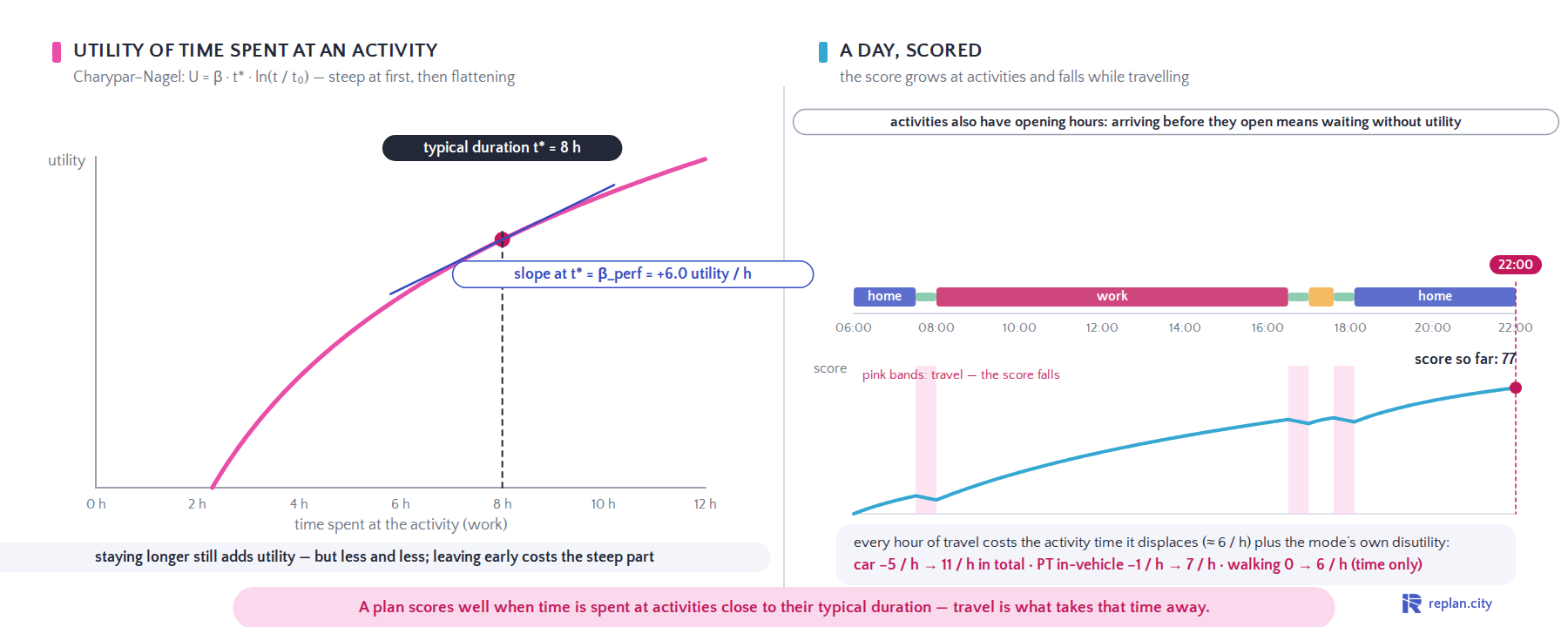
Charypar–Nagel: how an agent values time at an activity
A plan scores well when time is spent at activities close to their typical duration — travel is what takes that time away.
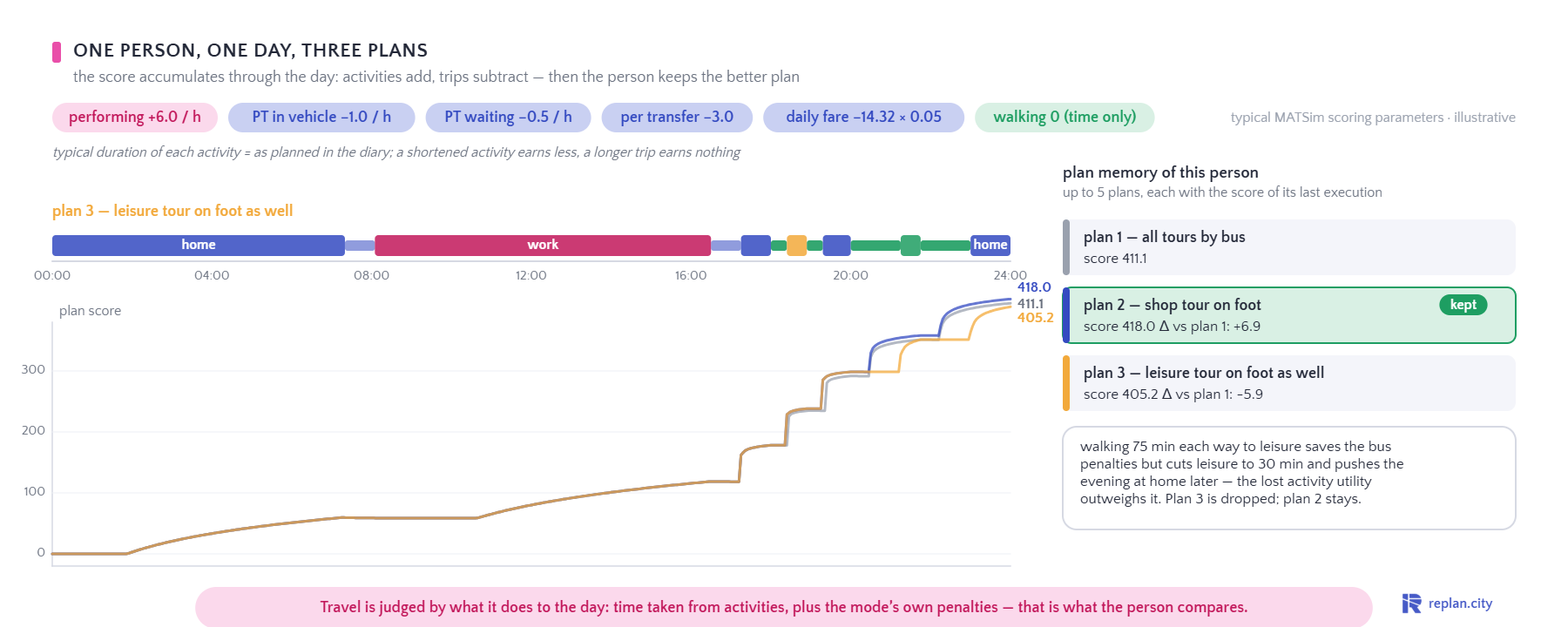
The scoring function at work
Travel is judged by what it does to the day — that is what the person compares.